Physical Address
304 North Cardinal St.
Dorchester Center, MA 02124
Physical Address
304 North Cardinal St.
Dorchester Center, MA 02124

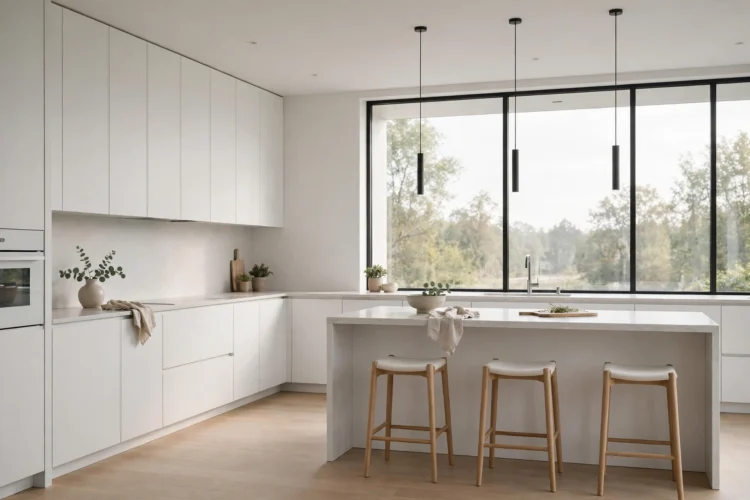
Flat-front slab doors are the fastest route to a handle-free kitchen, but the material and the opening system decide whether they still look good in five years.
Slab kitchen cabinets are flat-front doors with no frame, no panel, and no handle in the usual sense. The whole door is one smooth surface, which is why a slab kitchen reads as calm and modern even when the rest of the room is busy. The look is simple. The decisions behind it are not. The material, the edge, and the way the door opens all decide whether the kitchen still looks good after five years of daily use. These ten ideas cover each decision in turn, so you can pick a slab door that suits your budget and your habits.
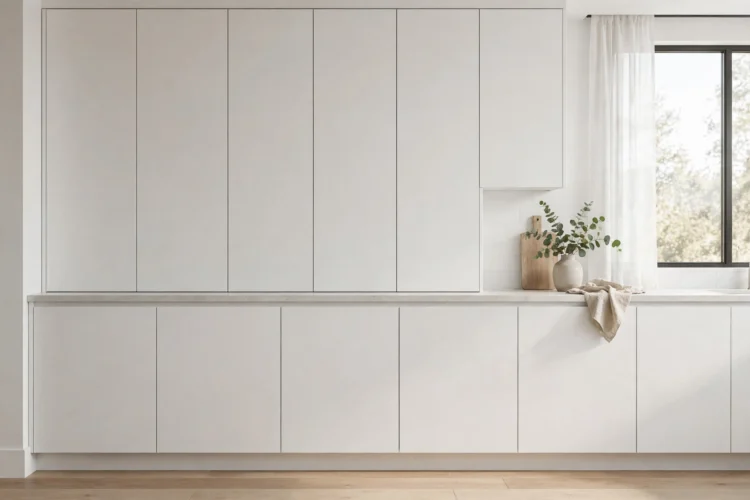
A slab door has nothing for the eye to catch on. No raised panel, no bevel, no knob casting a small shadow. That emptiness is the whole point. In a small kitchen it makes the wall read as one continuous surface instead of a grid of frames, and in a large kitchen it lets the island or the backsplash carry the visual weight. Flat front kitchen cabinets like these also forgive a busy room. If the floors are patterned or the counters are heavily veined, a flat door stays quiet and lets those surfaces lead.
The tradeoff is that a flat surface shows every flaw. A dent, a scratch, or a fingerprint stands out on a slab door in a way it never would on a framed panel. That is why the material and the finish matter more here than on any other door style. If the room is already plain, a slab door can feel blank, and that is when a wood veneer or a soft matte laminate has to do the work. Choose the surface first, then let the rest of the kitchen stay simple.
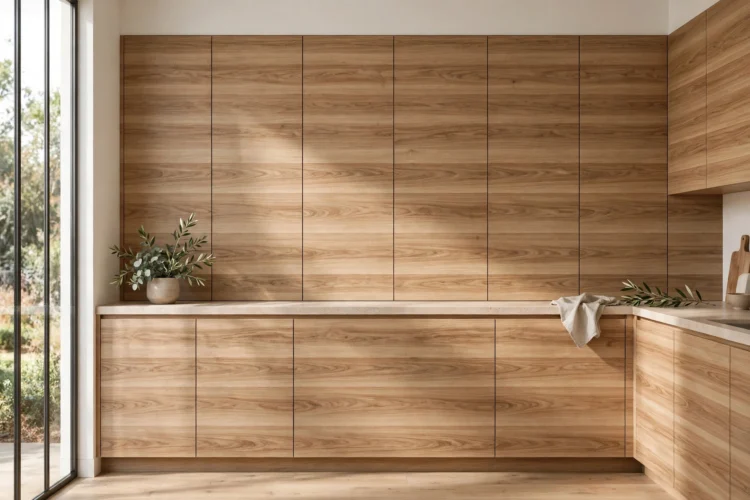
Wood veneer is a thin slice of real wood glued to a stable core, usually MDF. You get the grain and the warmth of solid wood at a fraction of the weight, and the door stays flat because the core does not move with the seasons the way solid boards do. Walnut, white oak, and rift-sawn oak are the usual choices, and the grain direction changes the whole feel of the room. Horizontal grain stretches a wall and makes a galley kitchen feel wider. Vertical grain makes tall doors look taller.
Veneer needs the same care as any wood surface. Keep it away from direct steam, so a kettle or a dishwasher vent should never blow straight onto a veneer door. Wipe spills right away and use a soft cloth, never a scouring pad. Book-matched veneer, where two sheets from the same log mirror each other across a pair of doors, is the detail that makes a veneer kitchen look custom instead of off the shelf. Ask to see it on a sample door before you commit to a full run.
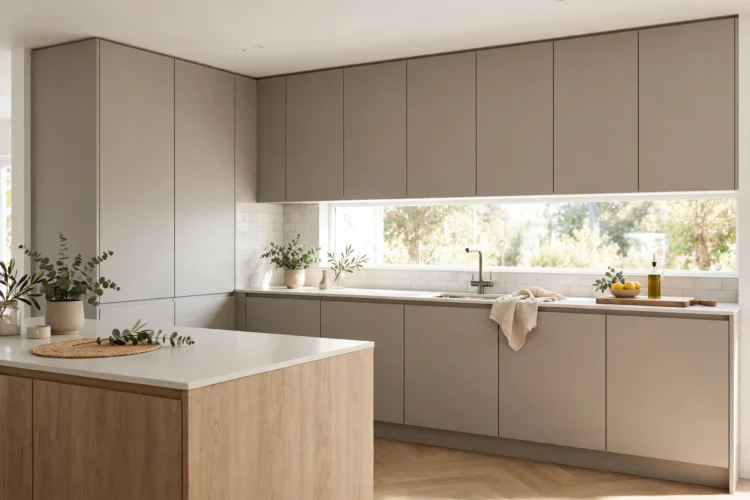
Laminate is a printed or solid-color sheet pressed onto a core, and it is the practical choice for a kitchen that gets heavy use. It resists stains, wipes clean with a damp cloth, and costs less than veneer or solid wood. A matte or soft-touch laminate hides fingerprints far better than a high-gloss sheet, which shows every touch and every smudge within an hour of cleaning.
The limit of laminate is that it cannot be refinished. A deep scratch or a chipped corner stays, so keep a repair marker in a matching color and touch up small damage as soon as it appears. When you order, ask for one spare door in the most-used size. It costs little at order time and saves a long wait if a door ever needs replacing. For the color, a warm white or a soft gray ages better than a stark white, which can look clinical once the rest of the kitchen warms up around it.
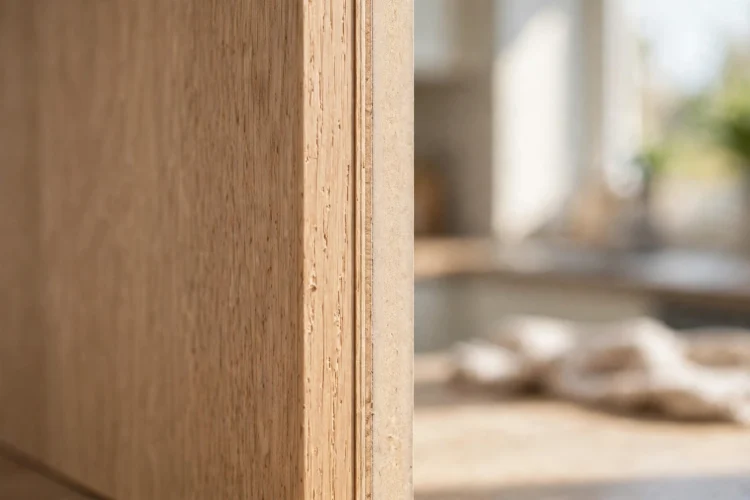
Edge banding is the thin strip that covers the raw edge of a slab door, and it is the first place a cheap door gives itself away. On a good door the banding matches the face in color and texture, and the seam is hard to find. On a poor one the banding is a slightly different shade, or it starts to peel at the corner after a year of steam and wiping.
Before you order, ask for a sample door and run a fingernail along the edge in daylight. The banding should feel flush, with no lip and no rough spot. Laser edge banding, where the strip is fused to the door without visible glue, holds up best in a kitchen, because there is no glue line for moisture to attack. A thicker edge, around 2mm, also survives bumps better than a thin foil edge. This is a small detail, but it is the one you will touch every single day.
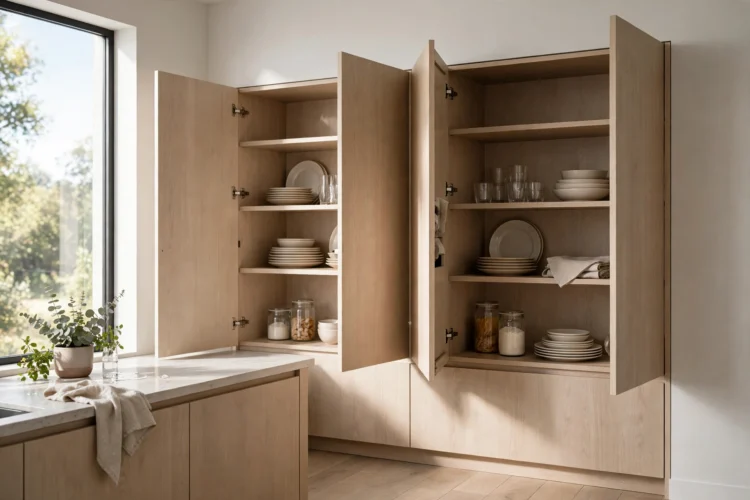
A touch latch is a small magnetic catch that opens the door with a push, so the front stays completely flat with no handle at all. It is the cleanest way to open a slab door, and it works best on upper cabinets and on doors you open a few times a day rather than fifty. Heavy or wide doors need a stronger latch, so check the weight rating before you choose. Handleless kitchen cabinets live or die by this opening system, so do not treat the latch as an afterthought.
Touch latch cabinets have one quirk worth knowing: a door can pop open if it is bumped hard, and a pet or a small child can learn the trick fast. Pair the latch with soft-close hinges so the door shuts quietly, and put child locks on the cabinets that hold cleaning supplies or sharp tools. If the push-to-open feel annoys you on a door you use constantly, keep the latch on the uppers and use a channel pull on the lowers instead.
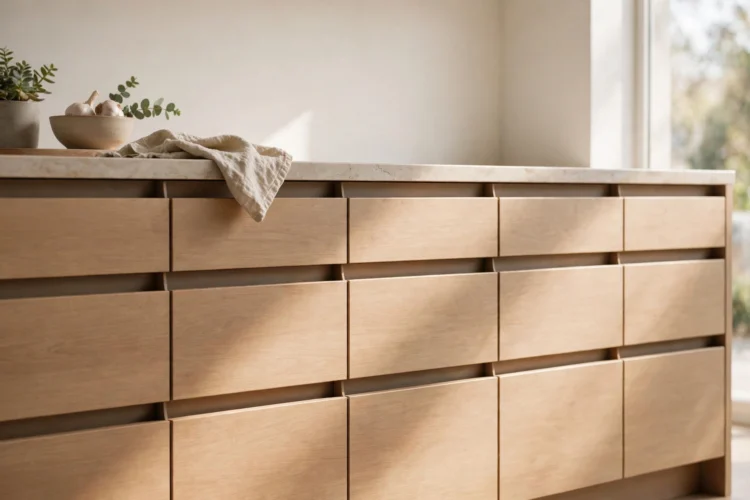
A channel pull, also called a J-pull or a finger rail, is a groove fitted into the top edge of the door or drawer. Your fingers catch the groove from underneath and pull, so the front still looks handle-free from across the room. An aluminum channel can be left silver for a subtle line or painted to match the door so it disappears entirely.
Channel pulls work best on drawers and base cabinets, where the rail sits at a natural hand height. On uppers, the rail has to sit at the bottom edge of the door, which means reaching up and under. Some people love that. Others find it awkward on the third shelf. Try it on a showroom door before you order a whole kitchen, and check that the groove is deep enough for your fingers. A shallow channel looks right and works badly, which is the worst combination.
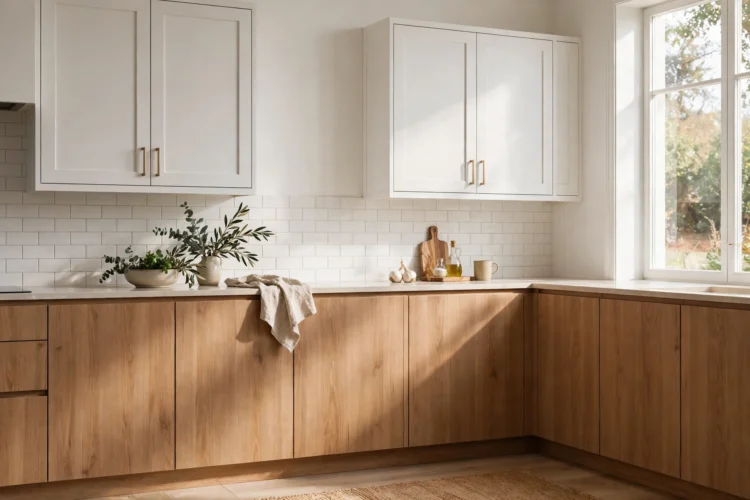
Slab on every door can feel flat, especially in a large kitchen where the walls run long. The fix is to keep slab on the lowers and use a different door on the uppers. Shaker uppers add a frame and a shadow line without breaking the modern feel, and glass uppers add display space and light. The contrast gives the eye something to rest on, and it breaks up the wall into two clear bands.
This mix also lets you spend where it shows. Put the premium material on the uppers at eye level and a simpler slab on the lowers, or the other way around if the island is the star of the room. These two-tone kitchen cabinet ideas show how a second color or material can make a flat-front kitchen feel custom, and these shaker cabinet ideas show the frame style that pairs best with slab lowers.
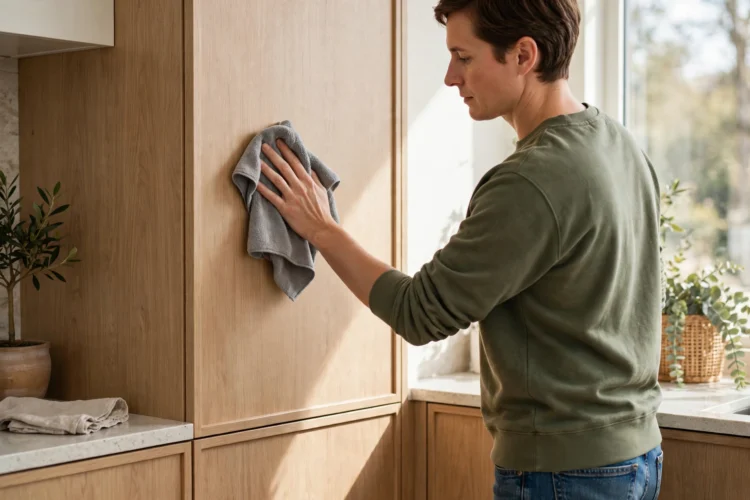
Flat doors show smudges, so the cleaning routine matters more than with a framed door. Wipe the doors once a week with a damp microfiber cloth and a drop of mild dish soap, then dry them with a second cloth so no water spots remain. Skip abrasive pads and harsh sprays on matte laminate, since they can polish a dull patch into the finish that never matches the rest of the door.
Check the hinges once a year. A slab door that sags by a few millimeters shows a crooked gap right away, because there is no frame to hide it. Most hinges adjust with a single screw, so a door that rubs or sits uneven can be fixed in five minutes. If you ever refresh the look, new hardware changes the whole kitchen for very little money. These kitchen cabinet hardware ideas cover pulls and knobs that work with flat fronts, and your cabinet color choice will decide whether the new hardware reads as a contrast or a quiet match.
A slab door kitchen stays sleek when the surface, the edge, and the opening system were all chosen on purpose. Pick the material that fits how you actually cook, test the latch or the channel pull before you order, and keep one spare door in the cupboard. The flat front does the rest.