Physical Address
304 North Cardinal St.
Dorchester Center, MA 02124
Physical Address
304 North Cardinal St.
Dorchester Center, MA 02124

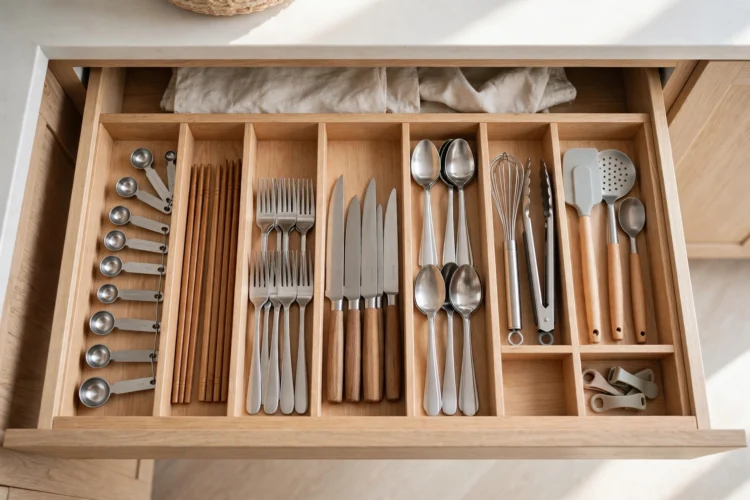
Eleven drawer ideas that give every utensil, knife, and lid a proper home, from adjustable dividers to deep-drawer systems.
Kitchen drawer organization sounds like a small job until you open a drawer and find a whisk tangled in a potato masher, a spatula wedged under a stack of lids, and three pairs of tongs you forgot you owned. Most drawers fail for the same reason: everything shares one open box, so the tools you grab daily end up buried under the ones you barely use. The fix is not a bigger drawer. It is a system that gives each tool a defined spot, sized to how often you reach for it. These 11 ideas cover dividers, knife docks, deep-drawer systems, and a few clever zones you may not have tried yet, and most of them install in under an hour with no tools beyond a tape measure.
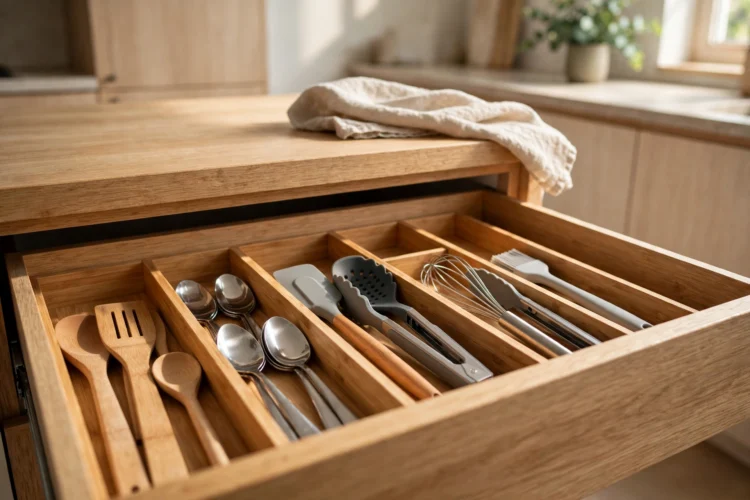
Adjustable dividers are the cheapest starting point, and they work in almost any drawer. Spring-loaded or slotted dividers split one wide drawer into lanes, so spatulas, tongs, and ladles each get a channel instead of sliding into a pile. Measure the drawer first, then buy a set that fits the depth and width with a little room to spare. Bamboo and plastic both work well: bamboo looks warmer and holds up over time, while plastic wipes clean after a spill. Drawer dividers for utensils work best when they adjust to the drawer, not the other way around, so pick a set with movable parts rather than a fixed grid. Leave one lane empty on purpose. That spare lane catches the odd tool that has no category yet, and it stops the whole system from breaking the week you buy a new peeler. For more ideas that squeeze storage out of tight kitchens, see these tiny kitchen storage ideas you can install this weekend.
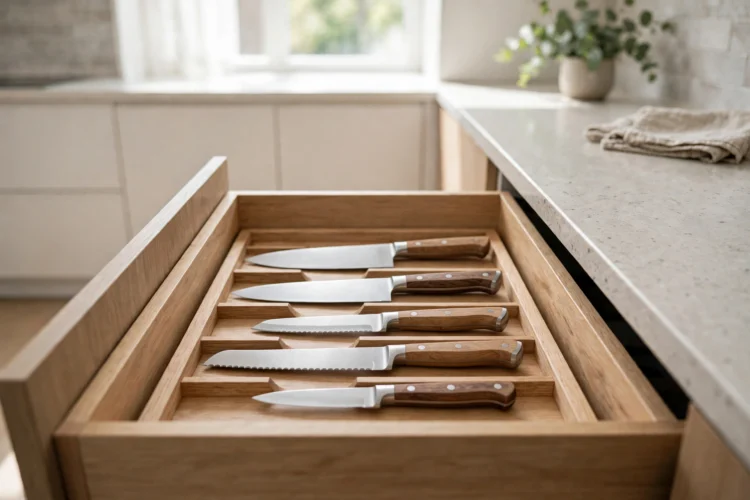
An in-drawer knife dock stores blades flat in angled slots, which keeps edges sharp and fingers safe. A block on the counter eats counter space, and a magnetic strip needs wall space you may not have, so the drawer dock suits small kitchens. A knife drawer organizer with slots in several widths works best, because a chef knife and a paring knife need different slots. Place the dock in the drawer nearest your main prep zone, not across the kitchen. Keep the blades facing the same direction and leave the first slot empty if you own fewer knives than the dock holds; an empty slot beats a loose blade every time. Wipe the dock down monthly, since crumbs and moisture collect in the slots. If your knives live in a block today, moving them into a dock frees a patch of counter you can use for chopping instead.
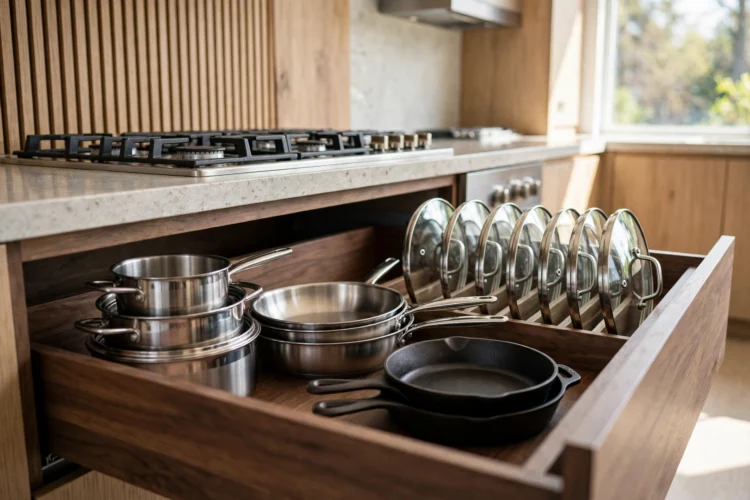
Deep drawers hold pots and pans better than low cabinets, because you pull the drawer out and see everything at once instead of crouching and reaching into the dark. Deep drawer organizers use pegs or adjustable dividers to keep stacks from sliding when the drawer opens and closes. Store lids separately, and stack pans by size with the most-used pan on top. A deep drawer near the stove works best, since pans travel the shortest distance from storage to burner. Add a non-slip liner under the stack so heavy pans do not shift and chip the drawer base. If your drawers are shallow, this idea still works for baking sheets and cutting boards stored flat. For more ways to make deep cabinets work harder, read these pull-out kitchen storage ideas for deep cabinets.
Lids cause most of the chaos in a pot drawer, so give them their own upright row. A simple file-style rack or a row of tension dividers holds lids on edge like books on a shelf, and you can read each size at a glance. Keep lids in the same drawer as their pots when space allows; when it does not, move the lids to the drawer directly above or below and mark the row with a small tag. Glass lids need a little padding, so a thin cork or felt strip along the rack edge stops chips. This one change frees up the stack space lids used to waste, and it ends the nightly clatter of lids sliding around every time the drawer moves.
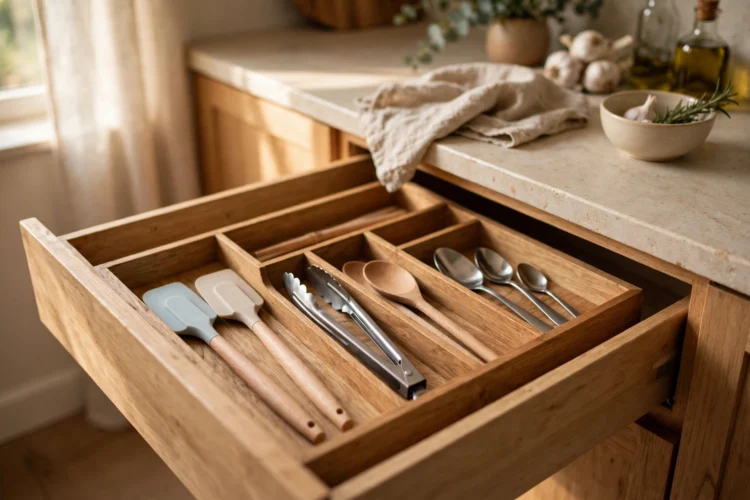
A tray with fixed compartments beats a loose pile for the tools you use at every meal. Pick a tray that matches the drawer size, then assign each compartment a job: one for serving spoons, one for spatulas, one for tongs, one for measuring tools. The rule that makes it stick is one tool per slot, so when a slot fills, you know you own a duplicate. Silicone trays grip the drawer base and stay put; wood trays look better but slide, so add a liner underneath. Wash the tray when you wash the drawer, and treat it as the daily driver while deeper storage handles the rest. If your drawer is narrow, choose a tray with a cutlery row on one side and a wider lane on the other.
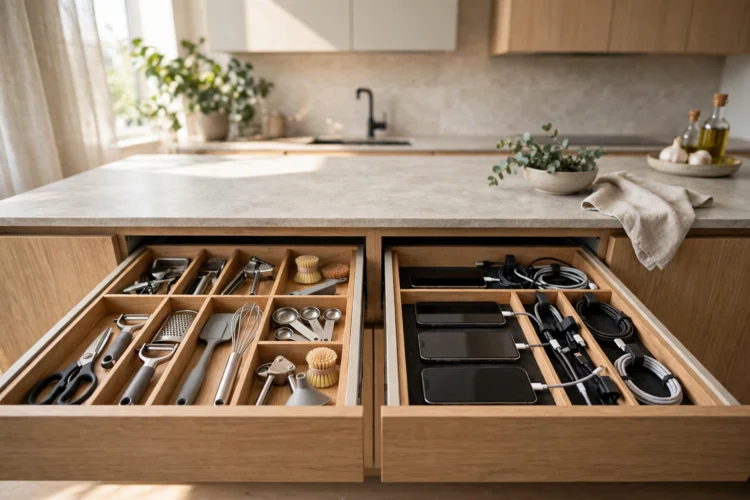
Gadgets like garlic presses, peelers, and thermometers vanish in a big drawer, so shrink the space they live in. A grid of small boxes or a cutlery-style insert with narrow slots keeps each gadget visible and stops them from nesting inside each other. Sort by task rather than by size: baking tools together, prep tools together, and serving tools together. That way you open one drawer for one job instead of hunting through three. Keep the gadgets you use weekly in the top drawer and move the once-a-month tools, like the cherry pitter, to a lower drawer. A label maker helps for the first month, until the layout becomes habit. The goal is not a perfect grid. It is a drawer where you can see every gadget without moving another one first.
A drawer with a power strip inside turns a junk drawer into a charging station. Mount a short power strip at the back of a shallow drawer, drill a small hole in the back panel for the cord, and keep phones and tablets in the drawer while they charge. Cables stay hidden, counters stay clear, and devices stay out of the splash zone near the sink. Use a strip with surge protection and keep the drawer away from the stove, since heat and charging cables do not mix. This works best in a drawer near the kitchen entrance, where family members naturally set their phones down. If you rent, a stick-on cable clip and a strip with an adhesive back give you the same result without drilling.
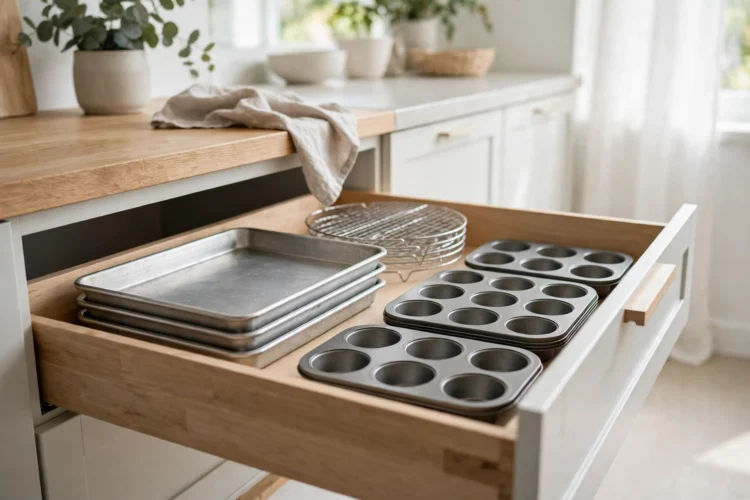
Baking gear stacks badly in cabinets, so give it a wide, shallow drawer. Store sheet pans flat, stacked by size, with cooling racks on top and muffin tins beside them. A divider running front to back splits the drawer into a pan lane and a tin lane, which stops the whole stack from sliding when you pull it open. Keep parchment, silicone mats, and cupcake liners in a small box at the front of the same drawer, so the baking drawer holds the full job from start to finish. If you bake rarely, move this drawer lower in the stack and give the prime spot to daily tools. If you bake weekly, keep it near the oven, where pans travel the shortest distance. For more compact storage ideas, browse these kitchen storage ideas for small spaces.
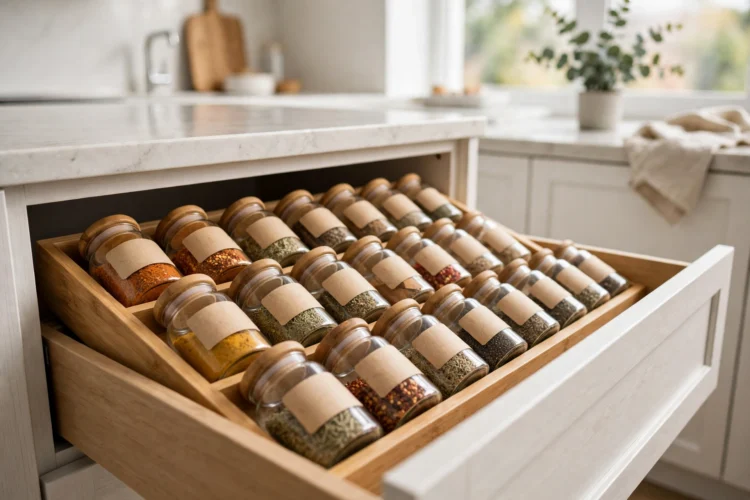
Spices belong in a drawer if you cook with them daily, because you can read every label at once instead of spinning a carousel. Angled inserts tilt jars so the lids face up, and a label on each lid turns the drawer into a spice index. Use matching jars so the drawer looks tidy and every jar sits at the same height. Sort alphabetically or by cuisine, and keep the five spices you reach for most at the front. A drawer near the stove saves steps, but keep it at least one drawer away from the oven heat, since heat dulls flavour over time. When a jar runs out, the empty slot reminds you to restock before you need it mid-recipe.
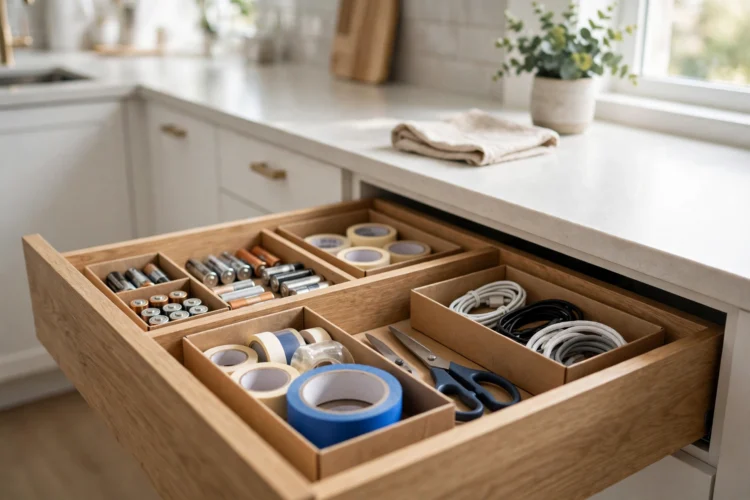
Every kitchen has a junk drawer, and the problem is never the drawer itself. It is the lack of zones. Split it into four zones: batteries and small tools, tape and scissors, chargers and cables, and the odds and ends that defy categories. Small boxes or repurposed containers work fine as zone walls. Once a month, pull the drawer out, toss anything broken or expired, and return stray items to their real homes. The junk drawer earns its keep when it holds only things that have no better home anywhere else. If an item has a real home, it does not live here. That single rule keeps the drawer from refilling, and it turns a monthly chore into a five-minute reset. If clutter keeps spreading past the drawer, these kitchen organization ideas for cluttered cabinets can help you reclaim the rest of the room.
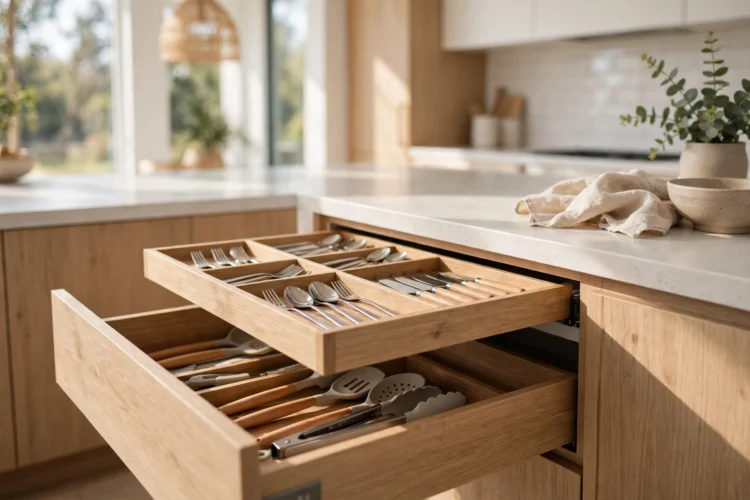
Shallow drawers waste their vertical space, and a two-tier insert fixes that. A sliding top tray holds cutlery and small tools, while the deeper bottom layer holds larger items underneath. You slide the top tray aside to reach the lower layer, which works well for items you need less often, like extra measuring cups or spare batteries. Measure the drawer height before buying, since the insert needs enough clearance to slide freely. This idea pairs well with a cutlery drawer near the dishwasher, where unloading goes straight into the top tier. It costs little, installs in minutes, and effectively gives you a drawer and a half.
Start with one drawer, the one you open most. Add dividers, move the knives into a dock, and give the lids a row of their own. Once that drawer works, the rest of the kitchen follows the same logic: a spot for each tool, sized to how often you use it. Good kitchen drawer organization is not a weekend project. It is one drawer, fixed properly, then the next.