Physical Address
304 North Cardinal St.
Dorchester Center, MA 02124
Physical Address
304 North Cardinal St.
Dorchester Center, MA 02124

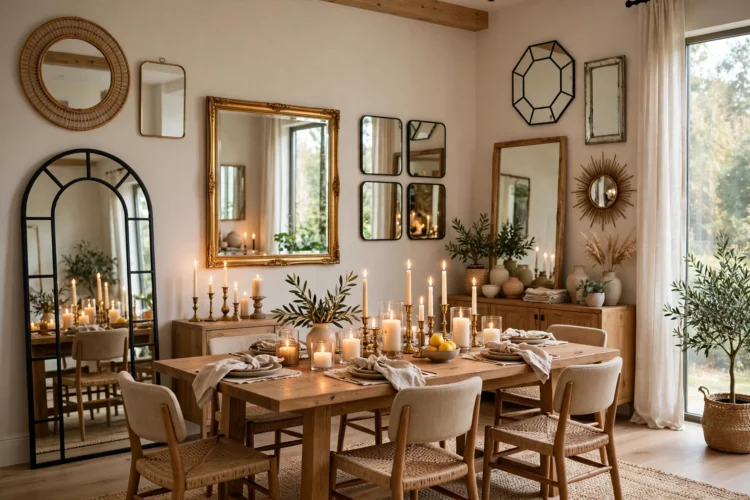
Mirrors do more than fill a blank dining room wall. Placed well, they double your candlelight, brighten dark corners, and make a small room feel twice as wide.
A mirror in the dining room is a light fixture that never needs wiring. Hang it across from a window or a chandelier and it throws that glow back across the table, so candles look twice as bright and the room feels wider after dark. These dining room mirror ideas cover shapes, sizes, and placements that work with real tables and real ceilings, not just showroom walls. The rule underneath all nine is simple: a mirror should reflect something worth seeing, so stand where you plan to hang it and check the view first.
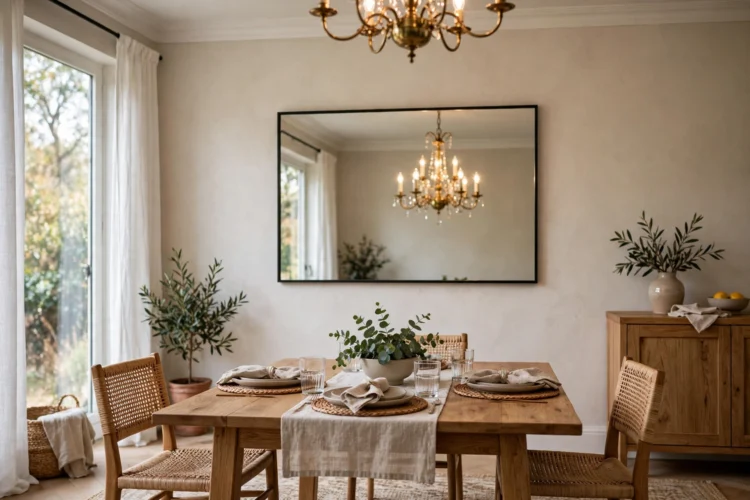
The easiest win is a mirror on the wall that faces the chandelier, or on the wall beside it at a slight angle. When the chandelier hangs between the mirror and the table, the mirror catches each bulb and sends the light back in a soft scatter that flatters faces and food alike. Size the mirror to the table, not the wall: a mirror about two thirds as wide as the table looks intentional, while a small mirror over a long table looks like an afterthought. Hang the center of the mirror at eye level when seated, roughly 60 inches from the floor to the center, so diners see the glow and the room, not the ceiling. If your chandelier is the star of the room, a plain framed mirror suits it better than an ornate one, because two statement pieces on opposite walls compete instead of cooperating. For chandelier sizing and hanging heights, these dining room chandelier ideas for every ceiling height pair well with every mirror idea below.
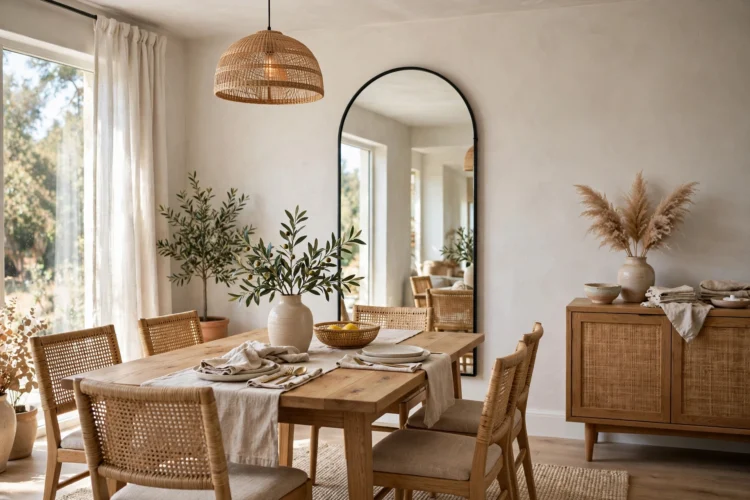
Dining rooms collect hard rectangles: the table, the sideboard, the windows, the chairs. An arched mirror breaks that pattern with one curved line, and the curve makes the whole room feel less stiff. Hang a tall arch on the longest blank wall, with its base about six inches above the sideboard or wainscoting, and let the arch rise toward the ceiling. The shape suits both modern rooms, where it reads as a soft architectural gesture, and traditional rooms, where it echoes old window shapes. Choose a thin frame in black metal for a modern look or a warm wood frame for a traditional one, and keep the frame quiet so the shape does the talking. A wide arch over a sideboard also doubles as a centerpiece backdrop: candles and a vase on the sideboard reflect in the glass, so the sideboard styling looks layered without extra objects.
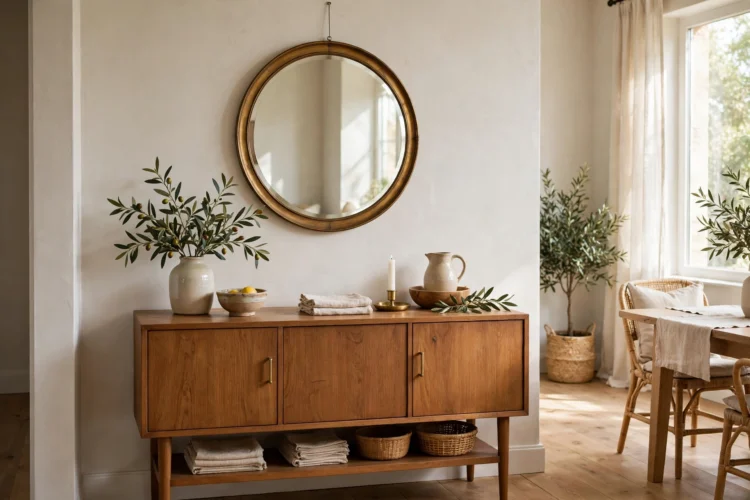
A round mirror above the sideboard is the dining room equivalent of a friendly face. It has no corners to fight the straight lines of the furniture, and it reflects light in every direction instead of one. Hang a round mirror 36 to 42 inches across above a standard sideboard, centered on the furniture, with its bottom edge about six to eight inches above the sideboard top. That gap leaves room for a lamp or a tall vase without crowding the glass. A round mirror also suits a wall with a chair rail or a low ceiling, because its curve stops well short of the ceiling and never makes the room feel cramped. Brass frames warm up a cool room, black frames sharpen a pale one, and a frameless round mirror disappears into a minimalist room and leaves only the light.
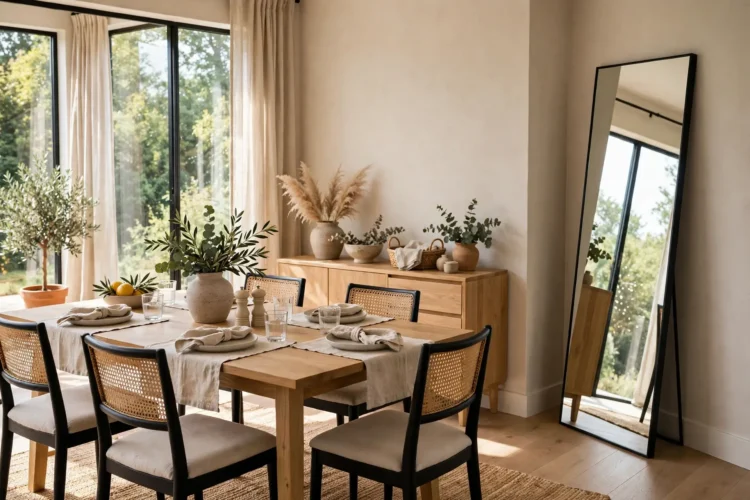
A tall mirror leaned in a corner does three jobs at once: it bounces light from the window, it fills an awkward empty corner, and it makes the room look deeper. Choose a mirror at least five feet tall so it reads as furniture, not as a mirror waiting to be hung, and lean it at a slight angle with the top resting on the wall and the base about six inches out from the skirting. Anchor the top to the wall with a small bracket or a picture hook so it cannot slide forward, especially in a house with children or pets. The lean works best in a corner near the table but not behind a chair, where a diner would bump it every time they stand up. Place a small plant or a floor vase in front of one edge to soften the corner where the mirror meets the wall.
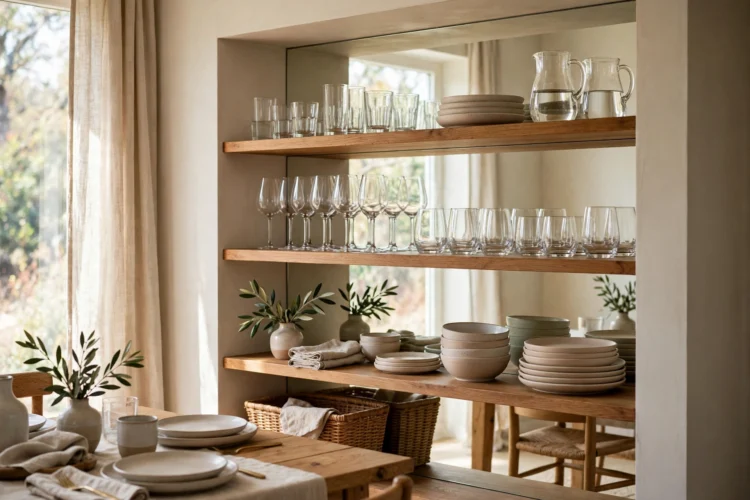
Fixing a mirror panel to the wall behind open shelves turns the shelves into a light box. Glasses and white dishes glow against the reflection, and the shelves look twice as deep as they are. Use a single mirror cut to the shelf width, or a row of mirror tiles with thin grout lines that read as a pattern. Keep the shelves shallow, about ten inches deep, so nothing sits far enough from the glass to cast a heavy shadow. This idea suits a dining room with a drinks station or a small hutch, where the shelves already hold glassware that catches light. Wipe the mirror weekly, because every fingerprint shows against glassware, and keep the shelf styling loose: three glasses, a small plant, and a stack of plates reflect better than a packed shelf that blocks the glass.
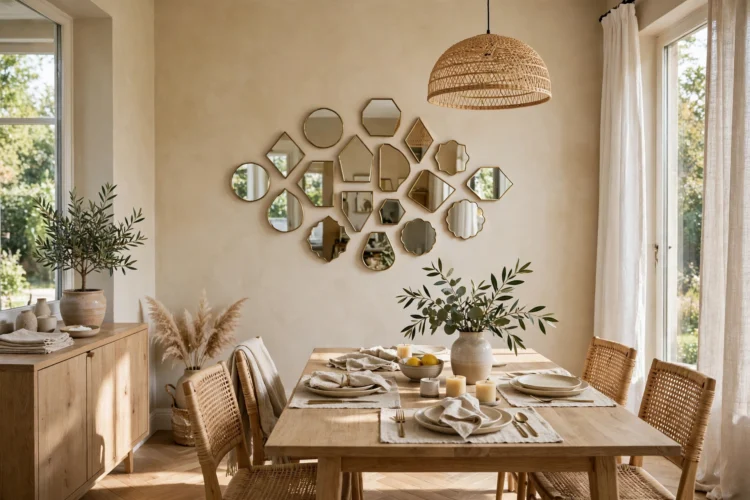
One big mirror is not the only option. A group of small mirrors in mixed shapes reads like wall art that happens to catch light, and it suits a wall too small for a single large piece. Hang five to seven small mirrors with two to three inches between them, following the same loose oval shape that works for a plate wall, and mix rounds, arches, and rectangles so the group feels collected rather than matched. Keep the frames in one finish, such as all brass or all black, so the mix holds together. Small mirrors work well on the wall beside the table, where diners catch glimpses of candlelight as they turn their heads, instead of staring into one large reflection all evening. They also suit a rental, because each one hangs on a single small hook.
Check the reflections as a group before you commit. Stand at the table and look at each mirror in turn. If three of them reflect the same blank wall, rearrange the group until most of them catch the chandelier, a window, or the table setting. A gallery of mirrors that all reflect nothing is just a set of dark shapes on the wall. For placement rules that apply to any wall arrangement, these mirror placement ideas that double the light show how angle and height change what a mirror gives back.
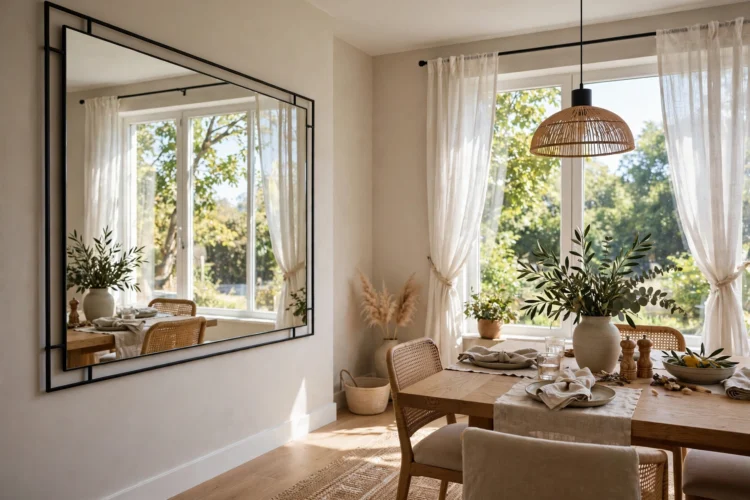
The classic placement still earns its reputation. A mirror directly across from a window catches daylight and throws it deep into the room, so a dining room that feels dim at lunch brightens without a new fixture. Size matters more here than anywhere: the mirror should be at least as wide as the window it faces, or the reflection looks like a small bright postage stamp on a large wall. Hang it so its center lines up with the center of the window, and check the view from the table at midday. If the mirror reflects the garden or the sky, the room gains a second view. If it reflects the neighbor’s brick wall, shift it to catch a corner of the window instead of the full view, or choose a different wall. Sheer curtains on the window soften the light the mirror returns, so the reflection glows instead of glaring.
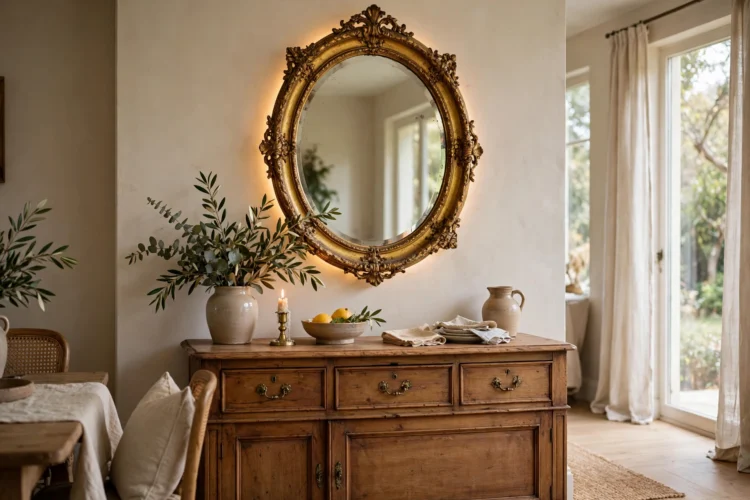
Bright clear mirrors can feel sharp in a room lit mostly by candles. Antique mirror glass, with its soft foxing and cloudy patches, and smoked mirror glass, with its gray or bronze tint, return a gentler glow that flatters skin and wood tones. Use them where the mirror sits close to the table, such as above a sideboard or on the wall beside the chairs, where diners see their own reflection up close. A smoked mirror above a dark wood sideboard looks almost like a window at dusk, while an antique mirror in a gilt frame suits a traditional room without shouting for attention. Both types cost more than clear glass, so use them on one feature mirror and keep clear glass for any second mirror in the room.
Hang a long horizontal mirror low on the wall beside the table, at the height of the table setting, and it reflects the plates, glasses, and candles as a second place setting. The effect makes a table for four look dressed for eight, and it photographs beautifully at dinner parties. Keep the mirror long and low, roughly 48 inches wide and 24 inches tall, with its bottom edge about 12 inches above the table height, so it reflects the setting and not the diners’ laps. A thin frame in the same finish as the table legs ties the mirror to the furniture, and a clear glass surface works best here because you want a sharp reflection of the table, not a soft glow. This placement suits a long wall in a narrow dining room, where a tall mirror would crowd the chairs.
Keep the table setting tidy when this mirror is in play, because it doubles every crumb and every crooked fork. Set the table, light the candles, then sit in each chair and check what the mirror shows from that seat. A centerpiece that looks full from the head of the table can look sparse in the mirror from the side, so add one low bowl of fruit or a second small candle where the reflection looks thin. When the mirror earns its place, the room feels dressed even before anyone sits down, and a well chosen dining table centerpiece for everyday and parties gives it something worth doubling.
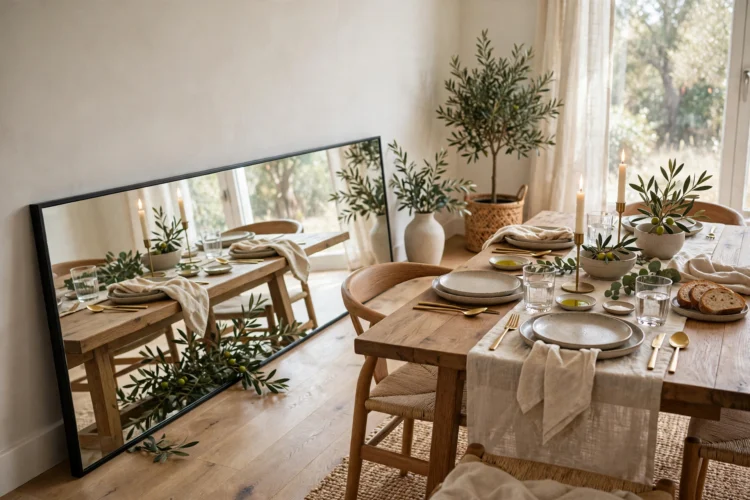
Start with the light you already have. Stand at the table, find the chandelier or the window, and hang the mirror where it catches that glow. Measure twice, test with the candles lit, and choose a shape that suits the furniture below it. A mirror hung well does not just decorate a dining room. It changes how the room feels at seven in the evening, when the candles are lit and the table is set, and that is the hour a dining room is made for.