Physical Address
304 North Cardinal St.
Dorchester Center, MA 02124
Physical Address
304 North Cardinal St.
Dorchester Center, MA 02124

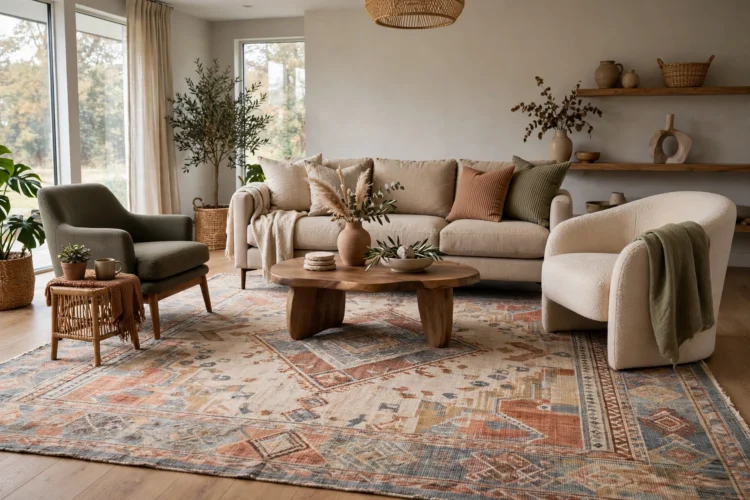
A rug is the fastest zoning tool a living room has: it tells the eye where the seating area starts and ends. These twelve ideas cover size rules, layering, and placement for open and awkward layouts.
Living room rug ideas start with one job: define the seating area so the furniture stops looking like it drifted. A rug draws a boundary the eye can follow, which is why a room with a rug feels arranged and a room without one feels temporary, even with the same sofa and chairs. The mistakes are almost always about size, not style. Buy too small and the furniture floats. Buy the right size and place the front legs on it, and the whole arrangement locks into place.
In an open layout, the rug does the work walls used to do. Without it, the sofa, dining table, and kitchen bleed into one long space with no resting point for the eye. Choose a rug large enough to hold the full seating group, not just the coffee table, and let its edges mark where the living zone ends and the next zone begins. If the open space holds two seating groups, use two rugs in the same palette family rather than one giant one; matching tones keep the room unified while each rug marks its own territory. Any rug size guide living room shoppers trust starts the same way: measure the seating group first, then shop for the rug that fits it, never the reverse.
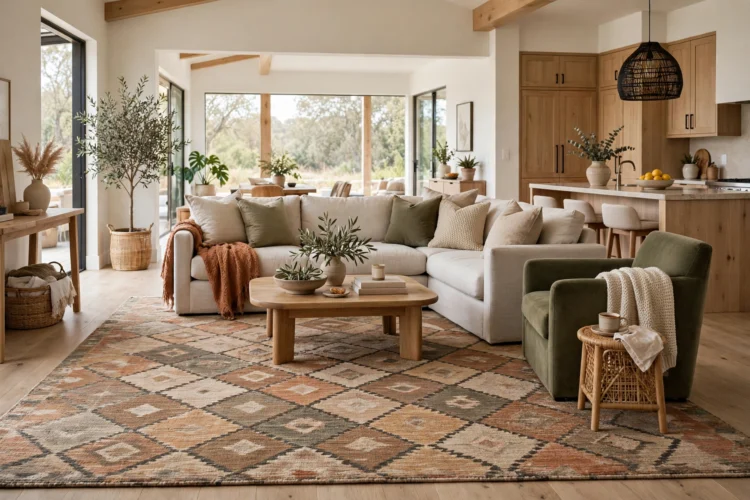
The floating-rug mistake happens when the rug is smaller than the furniture group, so chairs sit half on and half off the edge. Prevent it with three measurements. First, the rug should extend at least 15 to 20 centimeters beyond each side of the sofa. Second, the coffee table should sit fully on the rug with room to spare on all sides. Third, side chairs should have at least their front legs on the rug. Rug placement rules like these feel strict, but they exist because the eye reads the rug edge as the room edge; when furniture straddles that edge, the arrangement looks accidental. Measure the sofa width before shopping, since most size guides assume a standard three-seater and your sofa may run longer. When in doubt between two sizes, take the larger one. An oversized rug can be forgiven, but a small one announces itself every time you enter the room.
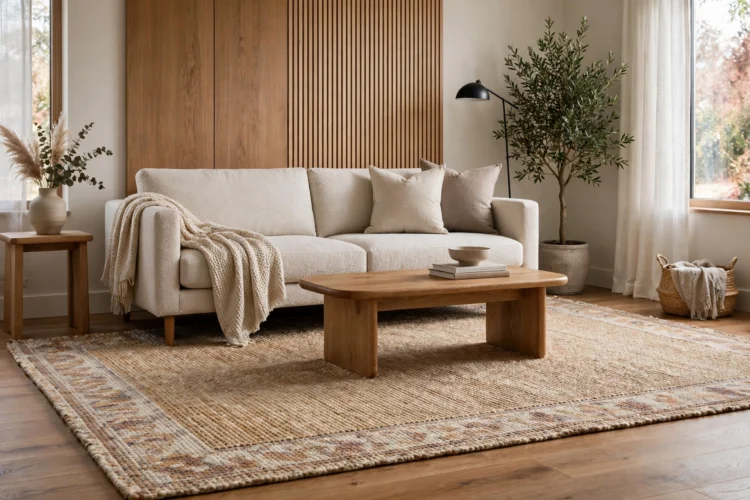
If you remember one placement rule, make it this: front legs on, back legs off is the minimum for a grounded arrangement. All four legs on the rug is ideal for large rooms, and it works when the rug is generous. Front legs only is the practical standard for most living rooms, and it still reads as intentional. No legs on the rug is the floating mistake, and it makes even expensive furniture look temporary. Test the rule before you buy by taping the rug outline on the floor with painter tape and placing the furniture inside it. Walk around the taped outline for a day. If the shape feels cramped, size up. If it feels generous, you found your rug. Tape costs almost nothing and prevents the most expensive rug mistake, which is buying twice.
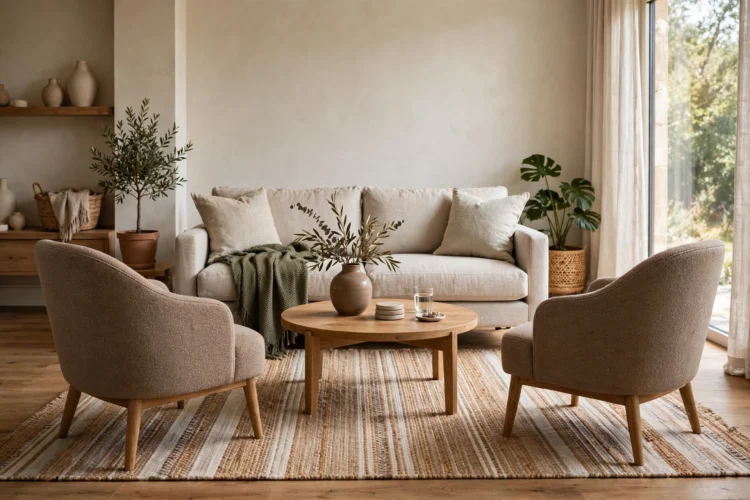
Layering rugs solves two problems at once: a large neutral rug you already own feels boring, and the patterned rug you love is too small or too expensive in a large size. Put the big neutral rug down first, centered on the seating group, then layer the smaller patterned rug on top, centered on the coffee table. Keep the top rug at about two-thirds the size of the base rug so the border of the base still reads. Layering rugs also adds warmth underfoot in rooms with hard floors, and it lets you change the look seasonally by swapping only the top layer. The same layering instinct guides bedroom rug placement, where a soft top layer over a flat base keeps the bed area warm without covering the whole floor.
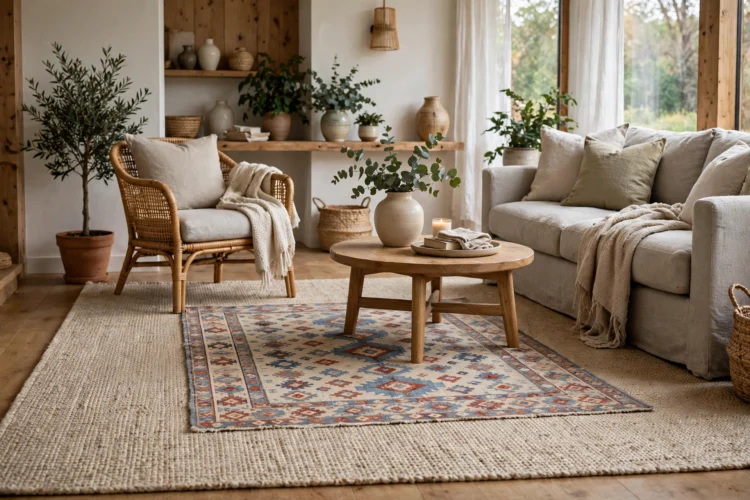
One long room can hold a living zone and a reading zone if each gets its own rug. The trick is contrast without clash: pick rugs that share a color family but differ in pattern or texture, so the zones read as related but distinct. Leave a strip of bare floor between the rugs, at least 30 centimeters, so the boundary stays visible. A reading chair with its own small rug and a lamp becomes a destination instead of a leftover corner, and the same idea shapes a master bedroom sitting area, where a small rug turns an empty corner into a place to sit. In living rooms, this zoning beats rearranging furniture, because moving a rug takes minutes while moving a sofa takes a weekend.
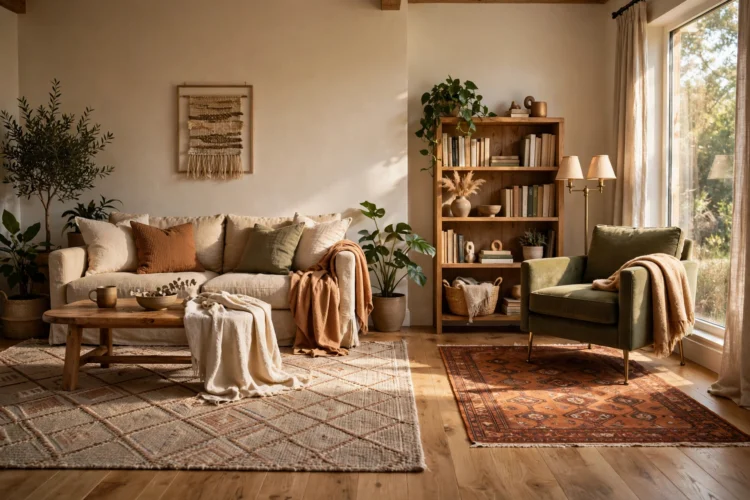
Living room rug material should match how the room actually gets used, not how it looks in a photo. Low pile or flatweave suits high-traffic rooms, dining-adjacent spaces, and homes with pets, because chairs slide easily and crumbs vacuum out. Medium pile adds softness underfoot in rooms where people sit on the floor or go barefoot. Natural fibers like wool resist stains better than they get credit for, while cotton rugs wash easily but wear faster in traffic lanes. If the room has a fireplace or heavy sun, check the material for fading and heat tolerance before committing. In homes with underfloor heating, check the rug backing for heat tolerance before buying, since some backings warp or trap heat. A rug that survives daily life beats a beautiful rug that spends its life rolled up in a closet.
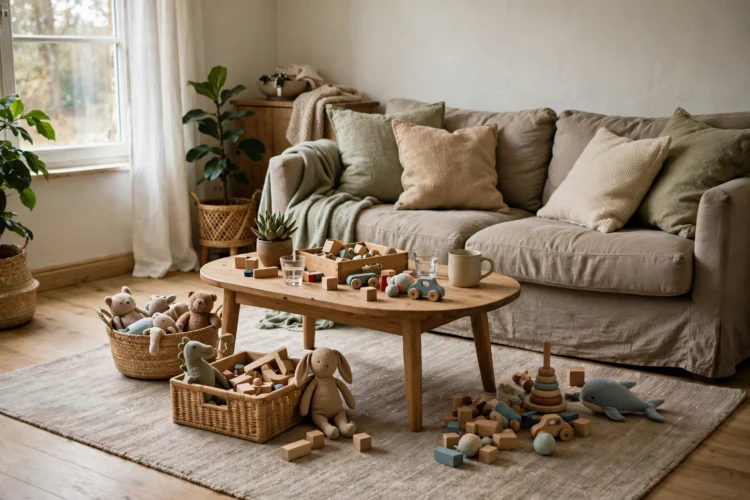
Long narrow rooms and L-shaped rooms break the standard rectangle logic, so adapt the shape. In a long room, run the rug lengthwise with the sofa and let it stretch toward the far end, which pulls the eye along the room instead of cutting it short. In an L-shaped room, treat each arm of the L as its own zone with its own rug, following the same split-zone approach. Round rugs work in square corners and under round coffee tables, where a rectangle would leave dead corners. Layout planning follows the same principle in smaller rooms too: the way a small bedroom layout squeezes function from an awkward footprint shows how measuring first and placing second beats buying first and hoping. Tape the outline, live with it a day, then commit.
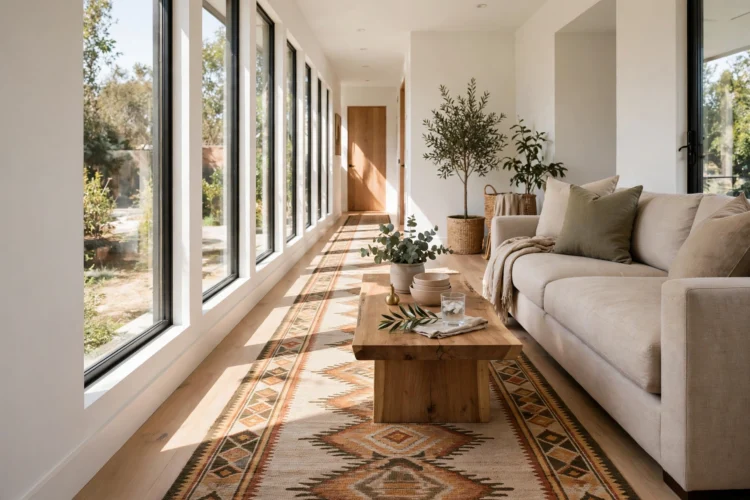
A rug that curls, ripples, or fades stops defining the seating area and starts distracting from it. Use a rug pad underneath: it prevents slipping, adds cushion, and stops the rug from bunching under chair legs. Vacuum with the beater bar off for looped and natural-fiber rugs, and rotate the rug 180 degrees twice a year so traffic and sun wear evenly. Blot spills immediately instead of rubbing, which pushes stains deeper into the pile. Keep the palette calm by echoing one color from the rug in the curtains or cushions, a trick that mirrors how a neutral bedroom stays cohesive by repeating a limited palette across surfaces. A flat, clean rug quietly does its zoning job for years.
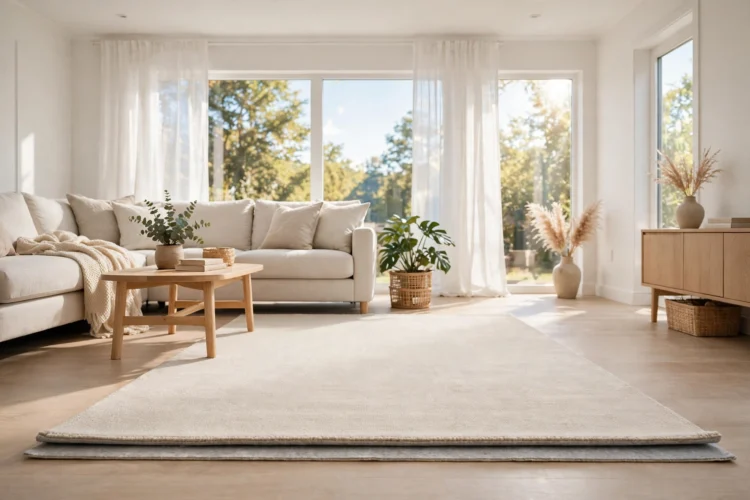
Measure the seating group, choose a rug that holds it, and put the front legs on. Everything else, pattern, pile, layering, is decoration on top of that one decision. Get the size right and the room arranges itself around it. And when a rug finally fits, the seating area stops needing explanation: guests sit down exactly where the rug tells them to.