Physical Address
304 North Cardinal St.
Dorchester Center, MA 02124
Physical Address
304 North Cardinal St.
Dorchester Center, MA 02124

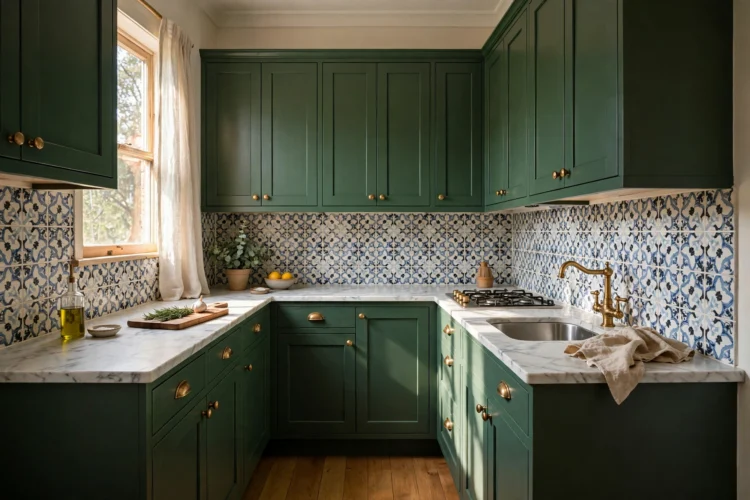
Eight bold small kitchen design ideas that prove a compact kitchen can carry big color, pattern, and personality without feeling crowded.
Small kitchen design ideas work best when they commit. A compact kitchen cannot hide behind square footage, so every choice shows: the cabinet color, the tile pattern, the light over the sink. That visibility is an advantage. A bold move that would get lost in a big open-plan kitchen lands with real impact when the room measures eight by ten feet.
The eight ideas below show that small kitchens can carry real personality without feeling crowded. Each one centers on a single confident decision, then keeps everything else calm so the star choice shines. Pick the one that matches your taste, your budget, and your willingness to live with color every morning.
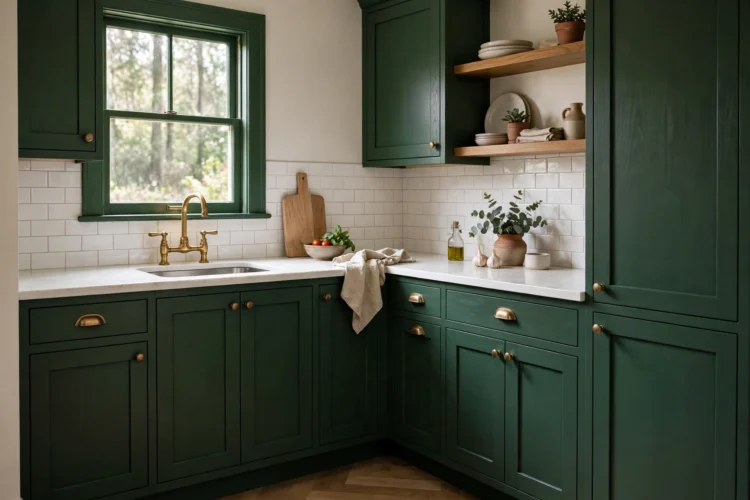
Deep forest green or inky charcoal cabinets change the whole mood of a small kitchen in one coat of paint. Dark cabinetry pulls the eye to the woodwork instead of the walls, which makes the room feel intentional rather than cramped. Keep the walls a soft warm white and the counters light, and the dark lowers read as furniture, not as a cave.
Pair dark cabinets with unlacquered brass pulls and a simple white subway tile backsplash so the color has room to breathe. Under-cabinet LED strips keep the work surface bright, which matters when the cabinet color absorbs light. A professional cabinet repaint typically ranges from $1,000 to $3,000 depending on kitchen size, while new cabinet fronts in a factory dark finish cost more but resist chips far longer. Ask for a cabinet-grade enamel in satin, since standard wall paint chips fast on doors that get touched dozens of times a day.
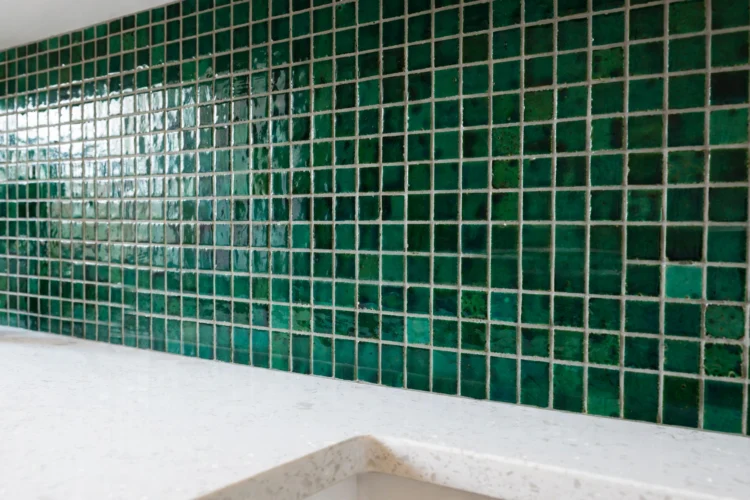
A small kitchen has maybe thirty square feet of backsplash, which makes it the cheapest place in the house to splurge on handmade tile. Zellige squares in deep emerald or cobalt give the wall a rippled, light-catching surface that flat ceramic cannot match. Run the tile all the way to the ceiling behind the range hood for one strong vertical line that draws the eye upward.
Keep the grout color close to the tile so the surface reads as one continuous sheet of color instead of a grid. With a busy backsplash, choose quiet counters: honed white quartz or light butcher block. Handmade-look tile typically ranges from $15 to $40 per square foot, so a small backsplash stays a weekend-scale project even at the high end.
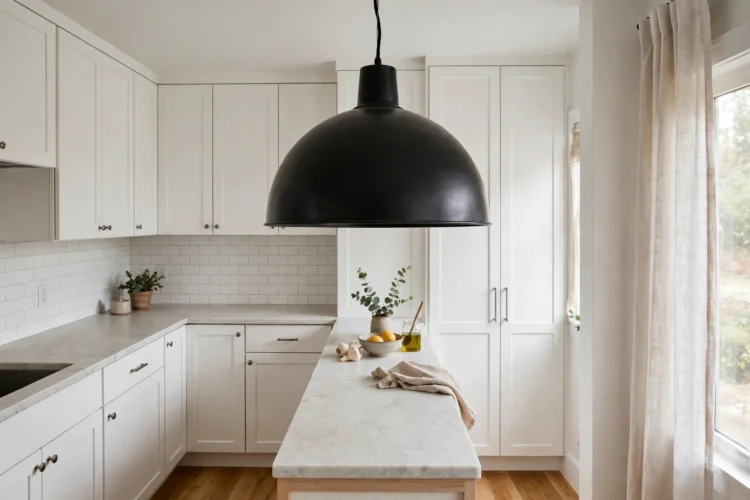
Instead of three small pendants crowded over a narrow island, hang one generous dome or drum pendant sixteen to twenty inches wide. A single large fixture gives a small kitchen a clear focal point and reads as a deliberate design choice, while a row of tiny pendants can look fussy in tight quarters.
Center the pendant over the island or the sink, and hang it so the bottom sits thirty to thirty-six inches above the counter. A black metal dome over white counters, or a woven rattan shade over wood tones, adds texture at eye level where small kitchens need it most. One statement pendant typically costs less than a set of three small ones, and the single junction box keeps installation simple.
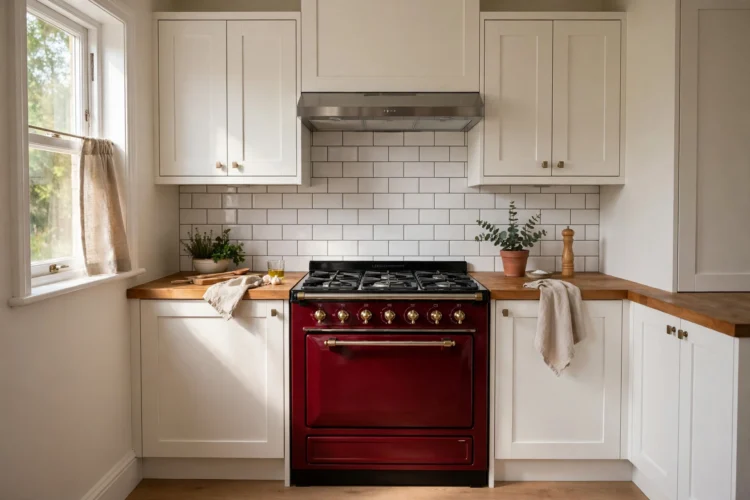
A thirty-inch range in deep red, racing green, or navy becomes the personality of the whole kitchen. In a small space the range sits close to everything, so its color shows from every angle. This works best when the rest of the kitchen stays neutral: white shaker cabinets, pale counters, and a quiet backsplash let the range do all the talking.
Colored ranges come from specialty makers and cost more than standard stainless, so treat this as the splurge piece and save elsewhere. Match at least one small detail to the range, such as a kettle or a row of cookbooks in the same hue, so the color feels planned rather than random. The result is a kitchen with a clear main character.
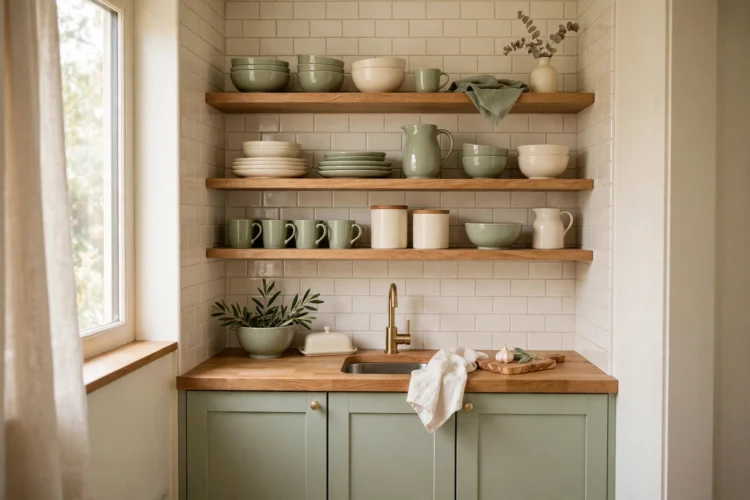
Removing two upper cabinets and replacing them with open wood shelves turns storage into display. The trick is editing: choose dishware and glassware in two or three related colors, such as cream, sage, and amber glass, and stack them in loose groups. A small kitchen shows its shelves from across the room, so the color story reads as intentional decor.
Use solid oak or walnut shelf boards at least ten inches deep, mounted on black steel brackets for contrast. Keep everyday items on the lower shelf and prettier pieces up high. Open shelving costs far less than new upper cabinets, and the air above the counter makes a galley kitchen feel wider the same day the shelves go up. Leave a little breathing room between stacks; crammed shelves read as clutter no matter how pretty the colors are.
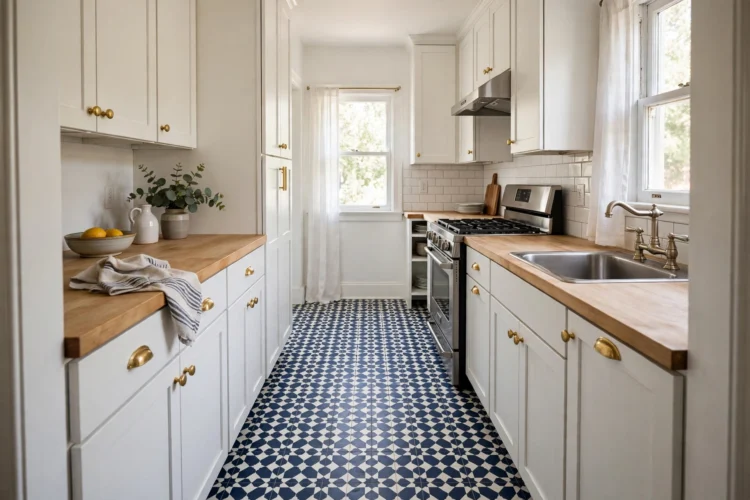
The floor is the largest uninterrupted surface in a small kitchen, and patterned tile there sets the tone for everything above it. Encaustic-look porcelain in an eight-by-eight geometric print, navy and white or terracotta and cream, gives the room a rug-like layer of pattern that never needs washing.
When the floor carries pattern, keep the cabinets and walls solid so the eye has somewhere to rest. Porcelain that mimics encaustic cement typically ranges from $5 to $12 per square foot and handles spills far better than real cement tile. Lay the pattern on the diagonal in a galley kitchen to pull the eye down the length of the room.
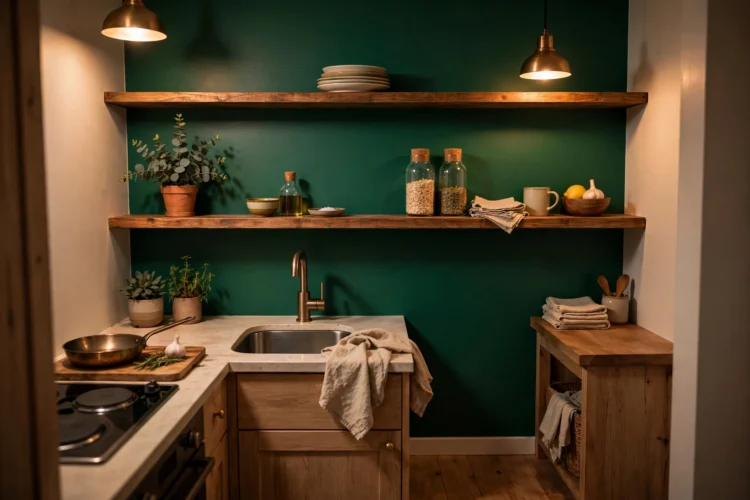
A single accent wall in emerald, sapphire, or aubergine gives a small kitchen depth that all-white walls cannot. Choose the wall behind open shelves or the breakfast nook, where the color frames something worth looking at. Jewel tones recede visually, so the wall feels farther away, not closer.
Repeat the wall color once more in the room, in barstool cushions or a small appliance, so it feels connected. Matte or eggshell finish keeps the color rich without glare. One gallon of quality paint covers the average kitchen accent wall with paint to spare, which makes this the lowest-cost idea on the list with one of the biggest visual payoffs.
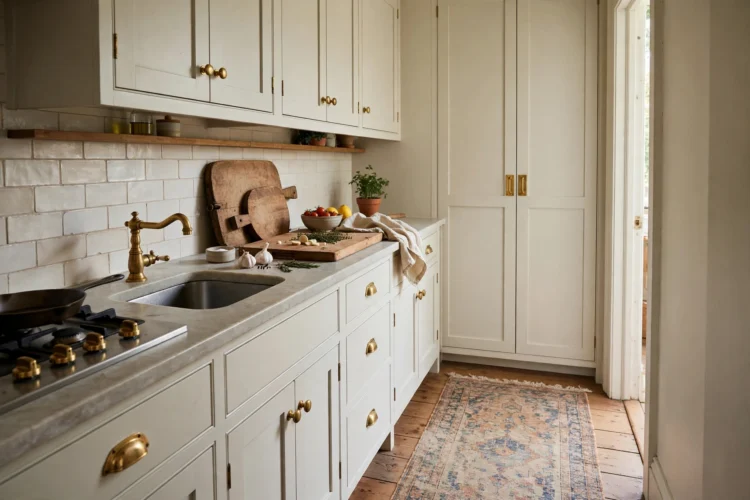
Unlacquered brass hardware, a faded vintage runner, and a few well-worn wood cutting boards give a small kitchen a collected feel that new-everything kitchens lack. Brass warms up white or gray cabinets, and because it develops a natural patina, it looks better with use instead of worse.
Choose a low-profile runner, about two and a half feet wide, that leaves the walkway clear. Swap every visible knob and pull for matching brass, including the faucet if the budget allows, since mixed metals read as clutter in a small space. Vintage runners typically range from $100 to $400 depending on size and age, and brass pulls run a few dollars each in multipacks.
A small kitchen rewards commitment. Pick one of these ideas, carry it through with confidence, and keep the surrounding choices quiet. The room will feel larger than its measurements because every inch looks like someone meant it.